Why does language learning always feel like such a slog?

And how do you fix it?

You probably know the feeling: You’ve just finished a lesson or a practice session, but you don’t think that you’ve made much progress. You still feel like you can’t really read, write, talk or understand what is said to you with the level of confidence that you’d like. And you’ve been feeling like this for months, if not years. (In my case, decades.)

Welcome to the second of the Four Stages of Competence – Conscious Incompetence, where you are only too aware of how much there is left to learn.

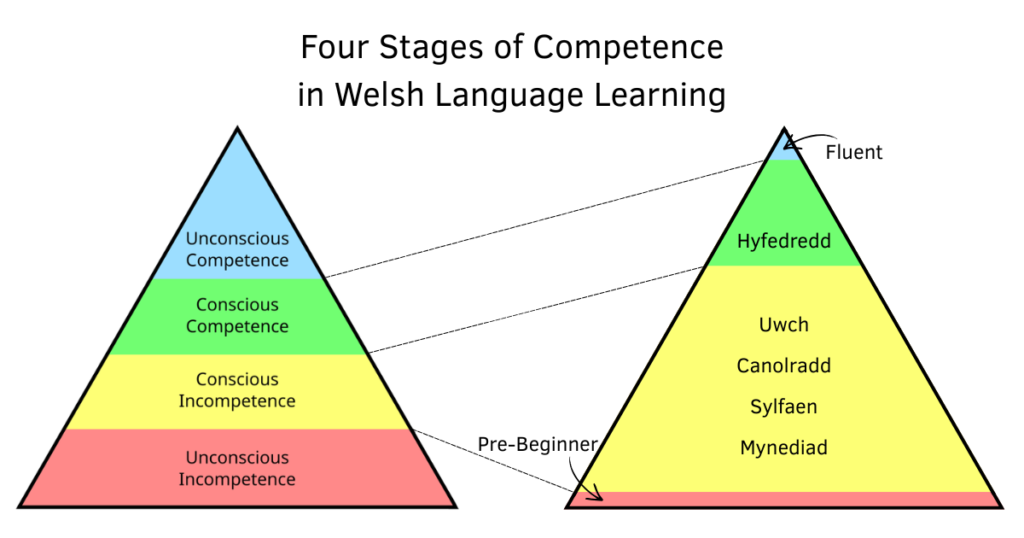
First suggested in the 1960s, the Four Stages of Competence outline how someone moves through the process of acquiring a skill. But how does that map to language learning?

1. Unconscious Incompetence

You don’t know how much you don’t know.

Honestly, the only point in the Welsh learning journey where this could possibly apply is that period before you actually start, when you might still believe that you really can learn a language in three months or with just 5 minutes of play per day. As soon as you start, you realise just how much there is to learn.

2. Conscious Incompetence

You understand that language learning is hard and that you have a lot to learn.

This covers most of your learning journey, from entry-level Mynediad courses all the way up to Uwch. At every stage you’ll be introduced to more grammar and more vocab. This is where it starts to feel like a slog.

3. Conscious Competence

You’re getting there, but you need to focus to get it all right and if your focus lapses you make mistakes.
Congratulations, you’ve reached Hyfedredd (Proficiency) and can now probably do most of the thing that you want to do, but you have to focus to do it.

4. Unconscious Competence

You’re fluent! Yay!


The majority of us spend most of our time in Stage 2, which means that we are constantly reminded that there’s so much more to learn.

After a while, that becomes demoralising and for lots of people it’s so dispiriting that they give up completely. Dysgu Cymraeg’s stats show that around 75% of learners give up after Mynediad (Entry) and never get as far even as Sylfaen (Foundation).

So how can we fix this?

What we need to do is split our learning into smaller chunks so that we can go through all four stages in a short space of time and finish with feeling of fluency. Lots of courses do this to some extent, but what’s often missing is the milestone that says “You have conquered this stretch! Well done!”

We can create that milestone ourselves using self-testing, something that I think a lot of learners shy away from because it just smacks too much of school.

But instead of looking at testing as a way to make you feel bad about what you don’t know, you can instead look at it as proving to yourself how much you’ve learnt and as showing you what you need to practice a little more.

With nothing important riding on the test and the opportunity to repeat it as often as you need to, self-testing is a valuable tool to help you understand how much you have mastered.

These opportunities to test yourself and understand how well you’re doing are built into Ymestyn. They are a fundamental part of the course and, because you’re in control of your learning journey, you can go back and do the tests (usually presented as games so they aren’t at all onerous) as often as you like.

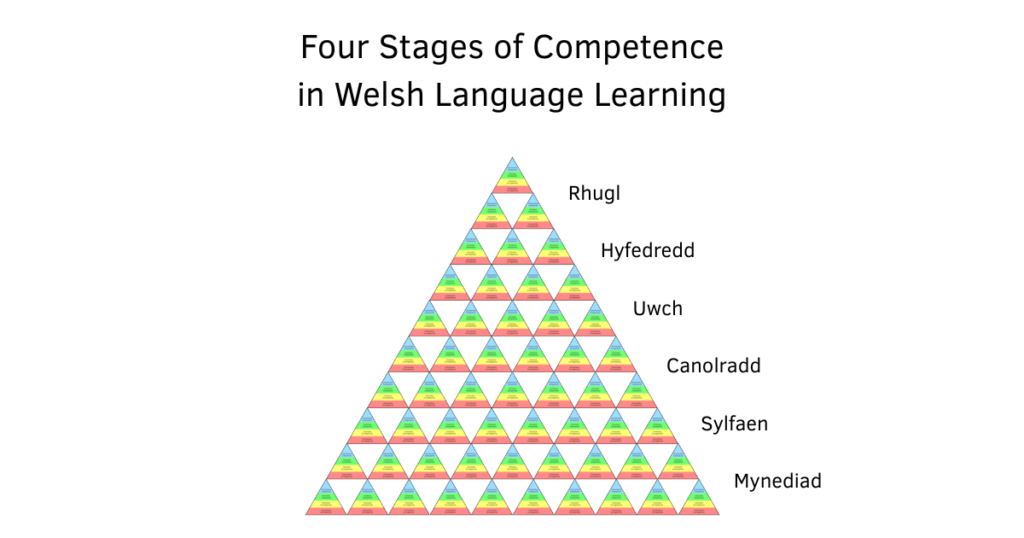
Instead of one long slog through the Four Stages of Competence, you develop unconscious competence in each skill, one at a time. We break that one big tedious pyramid into lots and lots of smaller and more manageable ones. By the time you get to the end of each little pyramid you know that you’ve properly learnt that skill and can feel confident and proud of your progress!

So if you’re a canolradd learner who wants to feel confident and proud of your progress, try Ymestyn today, the only structured practice course for intermediate learners!

Matthew Rhys on Widow’s Bay

Widow’s Bay is a fantastic new horror-comedy series on Apple TV starring award-winning Welsh actor, Matthew Rhys. In this interview for S4C’s Heno, he talks to Rhodri Owen about the new show, his boat and his experience performing Playing Burton, a single-man play about Richard Burton’s life. 

Watching short videos like this is a great way to expand your vocabulary, but it helps to learn the vocab before you watch. It can be tempting just to coast through and rely on the English subtitles to fill any gaps in your understanding, but you won’t really learn new words or phrases that way — learning takes focus and repetition. 

With Ymestyn, you don’t have to do all the hard work of pulling out the vocab, checking plurals and genders for nouns, and creating learning exercises, because I do all that for you. 

In the clip below, for example, there are dozens of words or phrases that you might not already know. it would take hours to list them all out (ask me how I know!), so to save you time, I’ve put the top 20 here for you to learn before you watch. 

  • plethu — to braid, to plait
  • tam (tamau) — morsel, bit
  • trigolyn (trigolion) — resident
  • anodd iddo neud — difficult for him to do
  • chwedl (chwedlau) — legend, myth
  • ar led  — about, around
  • shwt foi yw e?  — what kind of man is he? 
  • yn ni’n i gyd yn gwbod — we all know
  • fysa ma’ be’ — I don’t know what
  • mynnu — to insist
  • gor-hoff — overly fond, too keen
  • er gwaetha modd — unfortunately
  • rhwystr (rhwystrau) — obstacle 
  • cyfarwydd — familiar
  • fferyllydd (fferyllyddion) — pharmacist
  • canolbwynt (canolbwyntiau) — focal point
  • sai’n cael gweud — I can’t say
  • ta weud hwn — I can say this
  • crwt (cryts) — little boy, lad
  • cnaf (cnafiaid) — knave, scoundrel

The video has English subtitles burnt in, so if you can, find a way to cover those up so you’re listening just to the Welsh. 

How did you do? Did you hear all of these words and phrases? Were there any other bits that tripped you up? 

For the full list of words and phrases, plus exercises to learn them, sign up for Ymestyn today.

Update: 2 Jun – Es i, Des i and Matthew Rhys

Es i and Des i

I have now added exercises for the simple past of mynd (to go) and dod (to come), so that you can practice using those forms in context. Es i and des i are quite easy to use — if you would use I went or I came in English, you can just slot in es i and des i, in exactly the same way.

These two new exercises can be found right at the end of the course.

Matthew Rhys on Widow’s Bay

Last month, Heno’s Rhodri Owen interviewed actor Matthew Rhys about his latest hit TV show, Widow’s Bay, his boat and playing Richard Burton on stage. Although the interview is only about 6 minutes long, it’s crammed full of vocab and phrases, with lots in the south Wales dialect.

I’ve pulled out nearly 80 words or phrases and built exercises for you to learn them so that the video it makes more sense on first viewing.

Interviews like this, where native speakers are talking quickly and using lots of colloquial language, are really challenging so don’t worry if you don’t catch it all! As learners, we have to get used to a little ambiguity.

Learn some of the vocab and watch the video here.

Coming soon

I’ve got a lovely piece about Amgueddfa Genedlaethol Caerdydd’s Gwen John exhibition by Lauren Davies underway. And I’m halfway through the next set of exercises for the simple past of gwneud (to do, to make) and cael (to get, to receive).

Plus I have something fun up my sleeve that will be very different to what’s on offer via other Welsh courses. Stay tuned!

Update: 19 May – Speed Reading, This and that, Y Gelli Gandryll

Speed reading exercises

I’ve uploaded speed reading exercises for every section now, having nailed down a faster workflow to produce them. 

The idea behind speed reading is that you stop trying to translate in your head and instead try to think in Welsh itself. Speed reading doesn’t give you enough time to translate, forcing you to connect the word to the meaning without going via English.

Log in to give it a go and see what happens! 

New ‘This, That, These, Those’ section

I’ve put together a whole new section on how to say ‘this man’, ‘that man’ etc, addressing both the yma/yna system and the ‘hwn/hon/hyn’ system.

As learners, we tend to default to the simpler yma/yna system. But if we flip it on its head, we can use the hwn/hon/hyn as a tool to help us learn noun gender. The benefit to this is that not only do we learn noun gender, which can be quite a challenge for English speakers, but we also become more comfortable with the hwn/hon/hyn system which is used more widely in written Welsh.  

Y Gelli Gandryll’s famous bookshops

S4C have a short video about the bookshops of Y Gelli Gandryll (Hay-on-Wye) on their YouTube channel, so I’ve put together some vocab games and exercises to help you prepare. Once you’ve learnt the vocab, you’ll find the video much easier to watch! Log in to learn and watch!

Are we doing grammar all wrong?

I’ve spent a long time learning Welsh, and have spent large part of that long time trying avoid even thinking about grammar, let alone studying it. And I know I’m not alone – there are a lot of people on various forums asking how to learn without studying grammar, and even more people telling them that it’s actively damaging to study grammar explicitly.

What tosh!

What we need is to change our mindset around grammar. Instead of seeing it as a laborious chore, think of it as like Pokemon Go, as a set of skills to learn about and collect. And we need to bin this idea that grammar is about rules, and instead think about its application and what that allows us to do.

Update: 13 Apr 26 – New listening exercises are live!

New listening exercises

Over the last few weeks, I’ve focused on adding more audio to the site. The following sections now have audio exercises, where you listen to me saying a phrase and then pick the correct translation from the options.

  • Talking About Sports
  • Things We Know Aren’t True
  • Talking About Travel
  • Idioms 1

Audio is already a part of the Robin Goch and Titw Tomos Las sections and, over the next week or two, I’ll be recording the audio for the remaining sections.

Up next

I’ve been working on more video content for YouTube and Instagram, so hang tight for that! And I’m going to be adding more audio, a pop quiz to help you assess your progress, and more reading and listening.

Update: 23 Mar – New quizzes, five common idioms, Ymestyn in the news

Today’s Ymestyn roadmap update

I have upgraded the ‘Putting It All Together’ exercises by adding in ‘Type The Answer’ quizzes where you’re given an English phrase and have to type in the Welsh translation. This will help you with your recall and give you a sense of where you might need to go back and do a little more practice.

The sections on Gardening and Things To Do Around The House I have split into northern and southern versions so you can focus on your own dialect. Things We Know Aren’t True is split into taswn i and pe bawn i, so again, practice whichever version you would naturally use.

(If you’re wondering where tawn i went, I got feedback from one of my advisors that it’s rarely used so I removed it from the final exercise. I’ve kept it in the earlier exercises just so that you’re aware it exists.)

New section on idioms

I’ve added a new set of exercises looking at five common idioms:

  • teimlo i’r byw — to feel deeply
  • brifo i’r byw — to cut to the quick
  • yn ôl traed — in the footsteps of
  • o’r newydd — renewed, anew, once again, afresh
  • i’r carn — to the core, through and through, fully

I love idioms. They are a great way to sound more fluent, but a lot of courses don’t teach them directly, so these sessions aim to fill that gap.

Ymestyn in the news again

Ymestyn featured on the Herald Wales website, in connection with the recent report from Welsh Language Commissioner Efa Gruffudd Jones. Although she said that more work needs to be done to support the Welsh language, the report seemed to largely ignore us adult learners!

Record numbers learning Welsh

Over 20,000 people learnt Welsh via courses administered by the National Centre for Learning Welsh between August 2024 and the end of July 2025, new data shows. This is the highest number of learners since the NCLW’s records began in 2017/18, and an improvement on the pre-pandemic peak of 18,390 in 2019/20.

The data shows a large increase in the 16-24 year old bracket since 2018/19, going from 705 to 4,110 learners. The number of learners in the four decade-long age brackets between 25 and 64 all sit around the 3,000 to 3,400 level, showing a very healthy distribution of interest in the Welsh language across all working-age demographics. Indeed, counter to what one might assume, there are fewer learners in the 65-74 bracket (2,500), and only 790 older than 74. 

The top five locations for learners were: 

  • Cardiff:  3,020 (15%)
  • Outside Wales: 1,885 (9%) 
  • Gwynedd: 1,240 (6%)
  • Carmarthenshire: 1,010 (5%)
  • Wrexham: 1,005 (5%)

It’s great to see so many learners outside Wales, though I would have liked to see that number broken down into UK and Rest of the Word. However, it’s an indicator that more support needs to be given to people who aren’t living in Wales. The migration of young Welsh speakers to the rest of the UK is a significant threat to the Welsh language, so it’s important that we help them maintain or relearn their mother tongue regardless of where they live. 

I also find it interesting that Wrexham comes in fifth. Unfortunately, this is the first year that location data has been included, so I can’t look back to see if there’s been a rise in interest since the takeover of Wrexham AFC by Ryan Reynolds and Rob McElhenney in 2020. McElhenney especially has been a vocal supporter of the Welsh language, and their documentary, Welcome To Wrexham, features the language throughout. I would love someone at the NCLW to look at historic data to find out if there’s been an increase in learners since then. 

All that said, I am a bit worried about the low number of people who make it as far as the Intermediate stage. The NCLW said: 

Of the learners who are on courses at a specific level in 2024-2025:

61% of learners were at Entry level (which includes Pre-Entry). 14% were at Foundation level, 9% at Intermediate level, and 14% at Advanced and Proficiency levels.

2% have completed courses at Confidence-Building level, a new type of course for Welsh speakers who have lost confidence and want to use more Welsh.

Obviously, we need lots of people to come in at entry level, but I’d like to know why there are so few making it out of Entry, through Foundation and up to Intermediate. 

If you assume people spend a year doing Entry before moving on to Foundation, then over the last five years 74% to 77% of learners have been lost that transition point. There are bound to be some people who don’t continue for whatever reason — learning a language takes a lot of time and effort — but a reduction of three quarters feels like a lot. 

If we also assume people spend a year in Foundation before moving on to Intermediate, we’re losing between 25% to 29%, which isn’t too bad. But if we could persuade more people to stay on for a Foundation course, then our Intermediate numbers could look much better. Indeed, if we could reduce the loss from Entry to Foundation to 30%, we’d have three times as many learners at Foundation and Intermediate levels now.  

So what is stopping people progressing?

As an Intermediate learner myself, I think there is lack of resources for people at this level, which is obviously why I launched Ymestyn. But if we don’t get more people up to the Intermediate level, then we won’t get more fluent speakers and we won’t hit the Welsh government’s target of a million speakers by 2050.

Two key questions I’d love to see answered are: 

  • Are people just bailing out of the Learn Welsh program when they’ve completed Foundation, but continuing independently, so not showing up in their numbers?
  • Or are people bailing out of Welsh completely before they hit Intermediate? If this is the case, why? 

And, finally, looking at these numbers, it seems like it might be wise for me to develop Ymestyn so that it provides support to people doing Entry and Foundation courses. I do feel that there’s nowhere near enough support for Intermediate learners, but if this data is generalisable across the whole body of Welsh learners, then perhaps the problem starts earlier. 

What do you think? 

Update: 6 Mar – The simple past, new practice exercises and Nation.Cymru

Today’s Ymestyn roadmap update

Recent changes include:

  • New section covering the simple past (aka inflected preterite or inflected past) tense of what I think of as the Big Four, mynd (go), gwneud (do/make), dod (come) and cael (get).
  • Improvements to the Putting It All Together practice sections has begun. I’ve started to add ‘type the answer’ quizzes to each section, to provide a slightly more challenging way to practice which depends more on recall than recognition.

Ymestyn in the news

Ymestyn was also featured in Nation.Cymru where Jules Millward wrote about my plan to help learners become fluent by providing the kind of support that I’ve always been desperate for myself.