
If you’re supporting your staff in learning Welsh, then a company-wide Ymestyn subscription is an essential addition to the resources you provide for your employees.
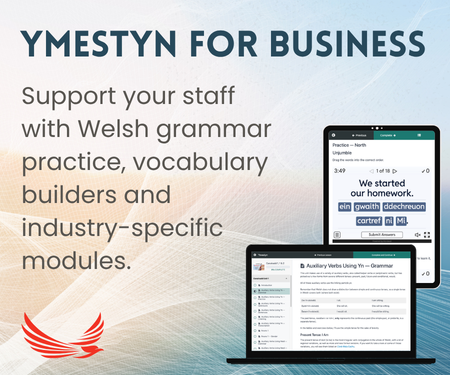
To be capable of confidently using Welsh in the workplace, learners need to reach at least an Intermediate or Advanced level, so that they have the language skills required to engage in meetings, have technical discussions, write emails, and speak with fluency and spontaneity.
The majority of materials currently available online, however, are targeted at Beginners or Foundation learners, with very little available for Intermediate learners. But it is impossible to progress from Beginner to Advanced without going through Intermediate!
Ymestyn solves the Intermediate problem
Ymestyn is the only online Welsh learning and practice resource for Intermediate/Canolradd learners. It provides learners with opportunities to go deep into key grammatical points and practice them until they become second nature. It expands students’ vocabulary and helps them learn nuances like noun gender.
Estimates very for how many words you need to know to reach a high enough standard to be able to work in Welsh, but to hold a meaningful conversation requires a lot of words, somewhere around 15,000. That kind of vocabulary acquisition does not happen in class alone, it requires additional study and seeing the same word repeatedly in context.
Ymestyn helps by providing learners with games and quizzes, plus interesting listening and reading practice, in an environment where they control what they learn and when. This means that they can focus on addressing their weaknesses and can revisit a module as often as they need to.
Confidence comes from knowing what you know, and frequent opportunities to self-test give learners the chance to develop a clear understanding of what they really do know and what they need to revise.
Customised learning for your workplace
Every industry has its specialist vocabulary which your staff will not learn in class, in general interest reading, or on S4C. If you require employees to understand technical terms, Ymestyn can work with a fluent speaker at your company to develop a module to teach those words.
Ymestyn has the creativity and tools, you have the specialist expertise, and together we can upskill your employees so that they are happy and confident using Welsh in your workplace.
If you’d like to find out more about group rates or customised modules, please email Suw Charman-Anderson.
Content and Language Integrated Learning
Content and Language Integrated Learning (CLIL) is a way of learning one subject through the medium of another, eg learning about nature through the medium of Welsh.
CLIL is an established framework which is sometimes called ‘content-based instruction’. It is, in fact, the basis of Welsh medium education – children learn other subjects, such as maths or geography, through the medium of Welsh.
Adult Welsh education, on the other hand, sticks to a language-only methodology, with a focus on learning how to use Welsh in social situations. And it focuses almost entirely on conversational Welsh, rather than written, formal or business Welsh.
Resources for learning Welsh via the CLIL method are few and far between, and most factual Welsh language content for learners is restricted in topic. Once you look at specialist or hobbyist topics, the content is focused on fluent speakers, not learners. And although there are graded reader books available, these are almost all fiction, which does not help learners develop the vocabulary to talk about their own personal interests.
CLIL content is essential for intermediate learners. It provides a way to bridge the gap between language-only learning and the experience of using Welsh in the real world.
Ymestyn is developing intermediate-level CLIL content, starting with short articles about the natural world, and will be expanding our CLIL offering as the program develops.
If, as a business, you have industry-specific Welsh language content that you would like to develop into a CLIL module for your employees, please get in touch.
Language levels
The National Centre for Learning Welsh provides courses at five levels, which correspond to the six language proficiency levels in the Common European Framework of Reference for Languages (CEFR).
To provide services to your customers or clients in Welsh, and to be able to collaborate confidently and communicate clearly, your Welsh learning-staff will need to reach a B1 or B2 level, which takes a lot of work and support.
Many learners get stuck on what is sometimes called ‘the intermediate plateau’, where they have a reasonable grasp of grammar and a growing vocabulary, but lack confidence and frequently come across words they don’t understand. They aren’t making the swift, visible gains they did as a beginner, but fluency still feels a long way away.
Intermediate learners need significant help to persist with their learning through what can be a very tedious period. Ymestyn is the only online program for Welsh leaners that provides this help.
| English | Welsh | CEFR | Level description |
|---|---|---|---|
| Entry | Mynediad | A1 | Can understand and use familiar everyday expressions and very basic phrases aimed at the satisfaction of needs of a concrete type. Can introduce him/herself and others and can ask and answer questions about personal details such as where he/she lives, people he/she knows and things he/she has. Can interact in a simple way provided the other person talks slowly and clearly and is prepared to help. |
| Foundation | Sylfaen | A2 | Can understand sentences and frequently used expressions related to areas of most immediate relevance (e.g. very basic personal and family information, shopping, local geography, employment). Can communicate in simple and routine tasks requiring a simple and direct exchange of information on familiar and routine matters. Can describe in simple terms aspects of his/her background, immediate environment and matters in areas of immediate need. |
| Intermediate | Canolradd | B1 | Can understand the main points of clear standard input on familiar matters regularly encountered in work, school, leisure, etc. Can deal with most situations likely to arise whilst travelling in an area where the language is spoken. Can produce simple connected text on topics which are familiar or of personal interest. Can describe experiences and events, dreams, hopes & ambitions and briefly give reasons and explanations for opinions and plans. |
| Advanced | Uwch | B2 | Can understand the main ideas of complex text on both concrete and abstract topics, including technical discussions in his/her field of specialisation. Can interact with a degree of fluency and spontaneity that makes regular interaction with native speakers quite possible without strain for either party. Can produce clear, detailed text on a wide range of subjects and explain a viewpoint on a topical issue giving the advantages and disadvantages of various options. |
| Proficiency | Hyfedredd | C1 | Can understand a wide range of demanding, longer texts, and recognise implicit meaning. Can express him/herself fluently and spontaneously without much obvious searching for expressions. Can use language flexibly and effectively for social, academic and professional purposes. Can produce clear, well-structured, detailed text on complex subjects, showing controlled use of organisational patterns, connectors and cohesive devices. |
| Proficiency | Hyfedredd | C2 | Can understand with ease virtually everything heard or read. Can summarise information from different spoken and written sources, reconstructing arguments and accounts in a coherent presentation. Can express him/herself spontaneously, very fluently and precisely, differentiating finer shades of meaning even in more complex situations. |