
And how do you fix it?
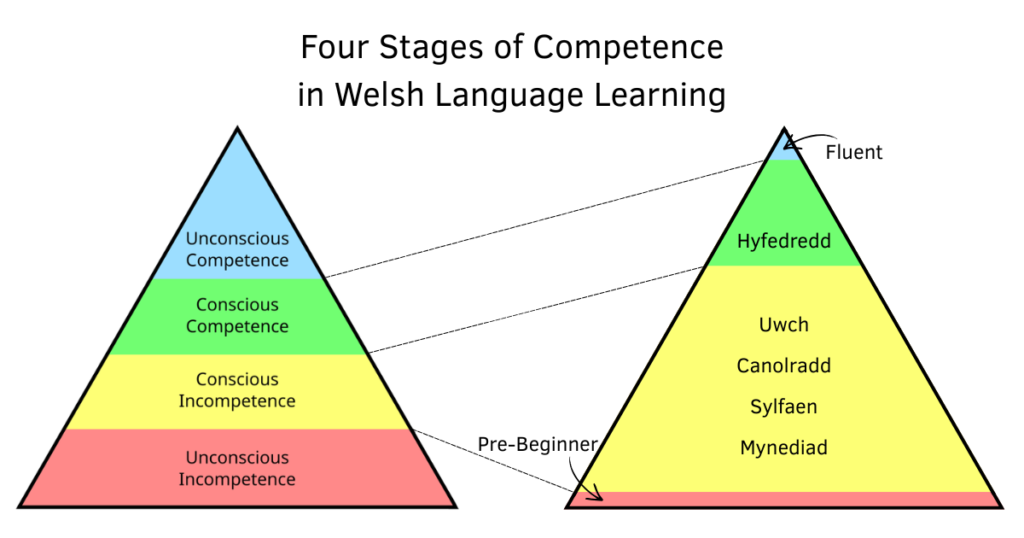
You probably know the feeling: You’ve just finished a lesson or a practice session, but you don’t think that you’ve made much progress. You still feel like you can’t really read, write, talk or understand what is said to you with the level of confidence that you’d like. And you’ve been feeling like this for months, if not years. (In my case, decades.)
Welcome to the second of the Four Stages of Competence – Conscious Incompetence, where you are only too aware of how much there is left to learn.
First suggested in the 1960s, the Four Stages of Competence outline how someone moves through the process of acquiring a skill. But how does that map to language learning?
1. Unconscious Incompetence
You don’t know how much you don’t know.
Honestly, the only point in the Welsh learning journey where this could possibly apply is that period before you actually start, when you might still believe that you really can learn a language in three months or with just 5 minutes of play per day. As soon as you start, you realise just how much there is to learn.
2. Conscious Incompetence
You understand that language learning is hard and that you have a lot to learn.
This covers most of your learning journey, from entry-level Mynediad courses all the way up to Uwch. At every stage you’ll be introduced to more grammar and more vocab. This is where it starts to feel like a slog.
3. Conscious Competence
You’re getting there, but you need to focus to get it all right and if your focus lapses you make mistakes.
Congratulations, you’ve reached Hyfedredd (Proficiency) and can now probably do most of the thing that you want to do, but you have to focus to do it.
4. Unconscious Competence
You’re fluent! Yay!
The majority of us spend most of our time in Stage 2, which means that we are constantly reminded that there’s so much more to learn.
After a while, that becomes demoralising and for lots of people it’s so dispiriting that they give up completely. Dysgu Cymraeg’s stats show that around 75% of learners give up after Mynediad (Entry) and never get as far even as Sylfaen (Foundation).
So how can we fix this?
What we need to do is split our learning into smaller chunks so that we can go through all four stages in a short space of time and finish with feeling of fluency. Lots of courses do this to some extent, but what’s often missing is the milestone that says “You have conquered this stretch! Well done!”
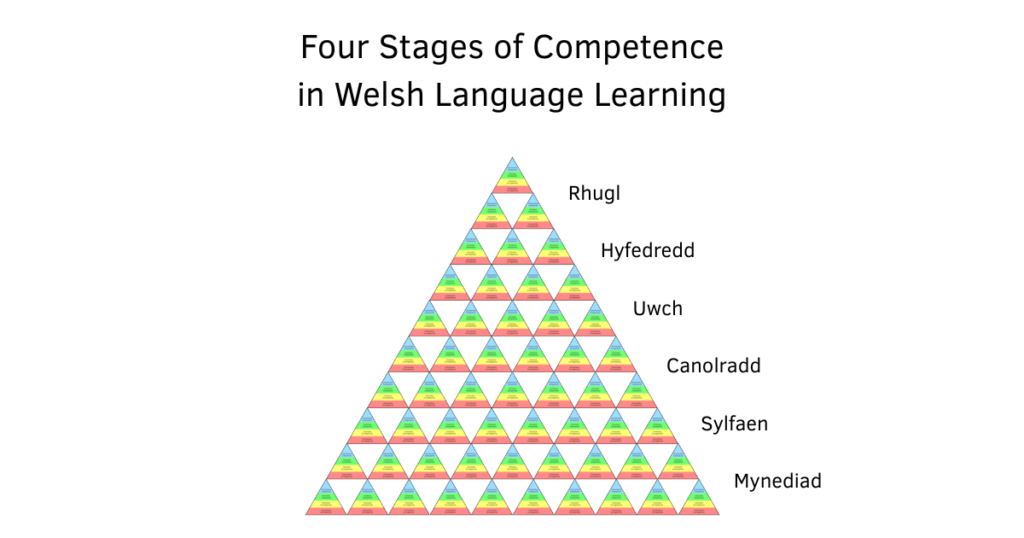
We can create that milestone ourselves using self-testing, something that I think a lot of learners shy away from because it just smacks too much of school.
But instead of looking at testing as a way to make you feel bad about what you don’t know, you can instead look at it as proving to yourself how much you’ve learnt and as showing you what you need to practice a little more.
With nothing important riding on the test and the opportunity to repeat it as often as you need to, self-testing is a valuable tool to help you understand how much you have mastered.
These opportunities to test yourself and understand how well you’re doing are built into Ymestyn. They are a fundamental part of the course and, because you’re in control of your learning journey, you can go back and do the tests (usually presented as games so they aren’t at all onerous) as often as you like.
Instead of one long slog through the Four Stages of Competence, you develop unconscious competence in each skill, one at a time. We break that one big tedious pyramid into lots and lots of smaller and more manageable ones. By the time you get to the end of each little pyramid you know that you’ve properly learnt that skill and can feel confident and proud of your progress!
So if you’re a canolradd learner who wants to feel confident and proud of your progress, try Ymestyn today, the only structured practice course for intermediate learners!