
Over 20,000 people learnt Welsh via courses administered by the National Centre for Learning Welsh between August 2024 and the end of July 2025, new data shows. This is the highest number of learners since the NCLW’s records began in 2017/18, and an improvement on the pre-pandemic peak of 18,390 in 2019/20.
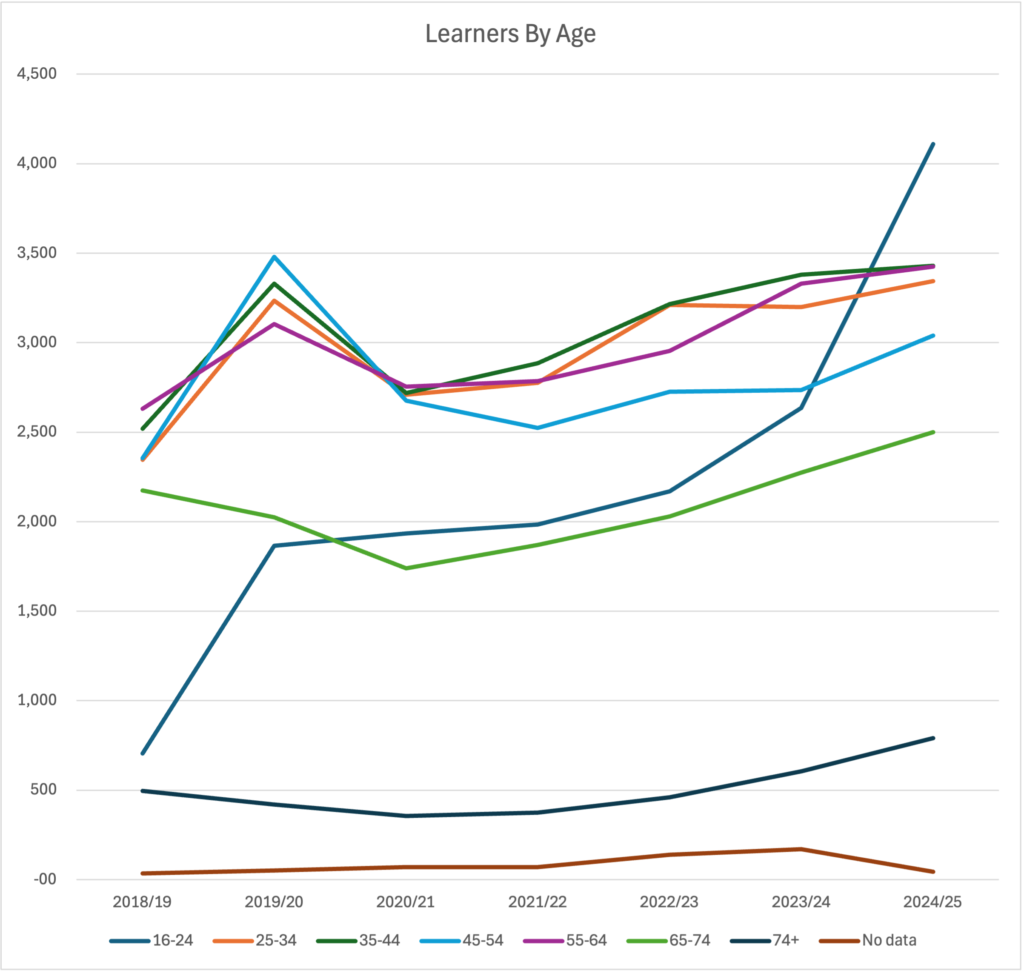
The data shows a large increase in the 16-24 year old bracket since 2018/19, going from 705 to 4,110 learners. The number of learners in the four decade-long age brackets between 25 and 64 all sit around the 3,000 to 3,400 level, showing a very healthy distribution of interest in the Welsh language across all working-age demographics. Indeed, counter to what one might assume, there are fewer learners in the 65-74 bracket (2,500), and only 790 older than 74.
The top five locations for learners were:
- Cardiff: 3,020 (15%)
- Outside Wales: 1,885 (9%)
- Gwynedd: 1,240 (6%)
- Carmarthenshire: 1,010 (5%)
- Wrexham: 1,005 (5%)
It’s great to see so many learners outside Wales, though I would have liked to see that number broken down into UK and Rest of the Word. However, it’s an indicator that more support needs to be given to people who aren’t living in Wales. The migration of young Welsh speakers to the rest of the UK is a significant threat to the Welsh language, so it’s important that we help them maintain or relearn their mother tongue regardless of where they live.
I also find it interesting that Wrexham comes in fifth. Unfortunately, this is the first year that location data has been included, so I can’t look back to see if there’s been a rise in interest since the takeover of Wrexham AFC by Ryan Reynolds and Rob McElhenney in 2020. McElhenney especially has been a vocal supporter of the Welsh language, and their documentary, Welcome To Wrexham, features the language throughout. I would love someone at the NCLW to look at historic data to find out if there’s been an increase in learners since then.
All that said, I am a bit worried about the low number of people who make it as far as the Intermediate stage. The NCLW said:
Of the learners who are on courses at a specific level in 2024-2025:
• 61% of learners were at Entry level (which includes Pre-Entry). 14% were at Foundation level, 9% at Intermediate level, and 14% at Advanced and Proficiency levels.
• 2% have completed courses at Confidence-Building level, a new type of course for Welsh speakers who have lost confidence and want to use more Welsh.
Obviously, we need lots of people to come in at entry level, but I’d like to know why there are so few making it out of Entry, through Foundation and up to Intermediate.
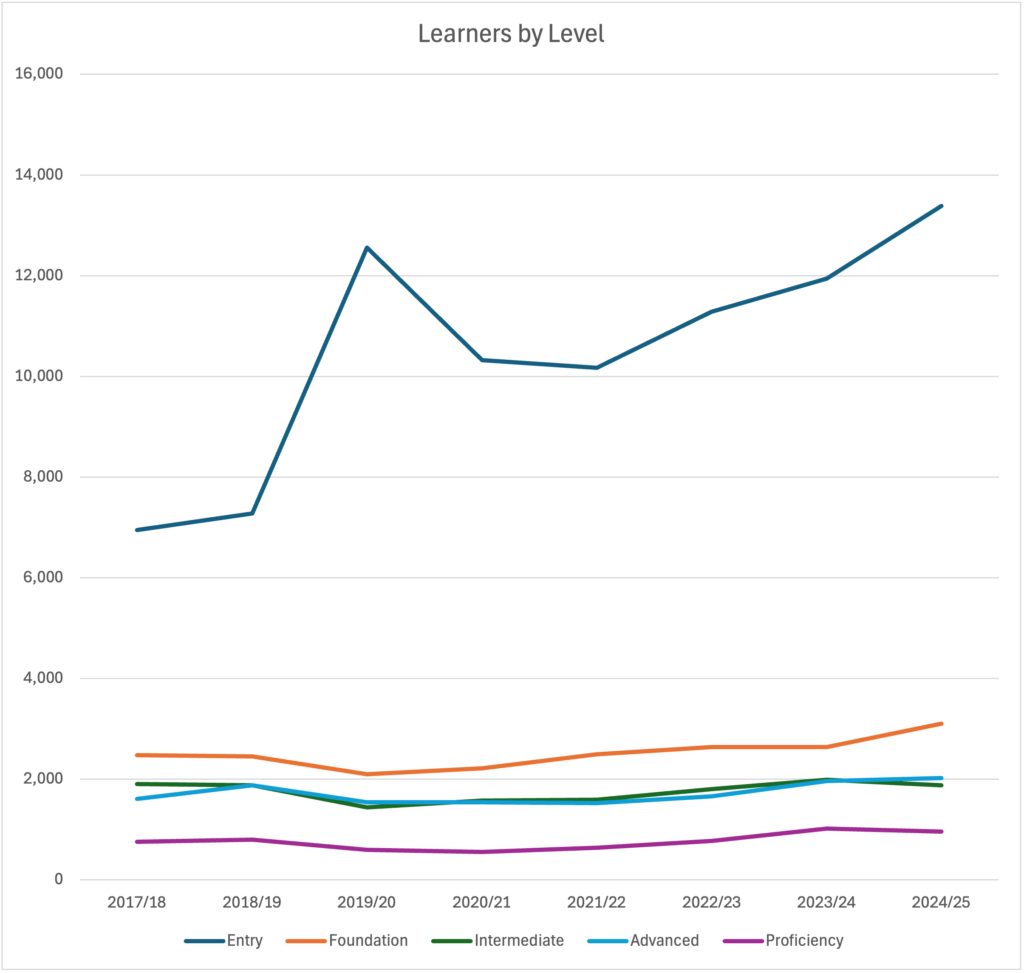
If you assume people spend a year doing Entry before moving on to Foundation, then over the last five years 74% to 77% of learners have been lost that transition point. There are bound to be some people who don’t continue for whatever reason — learning a language takes a lot of time and effort — but a reduction of three quarters feels like a lot.
If we also assume people spend a year in Foundation before moving on to Intermediate, we’re losing between 25% to 29%, which isn’t too bad. But if we could persuade more people to stay on for a Foundation course, then our Intermediate numbers could look much better. Indeed, if we could reduce the loss from Entry to Foundation to 30%, we’d have three times as many learners at Foundation and Intermediate levels now.
So what is stopping people progressing?
As an Intermediate learner myself, I think there is lack of resources for people at this level, which is obviously why I launched Ymestyn. But if we don’t get more people up to the Intermediate level, then we won’t get more fluent speakers and we won’t hit the Welsh government’s target of a million speakers by 2050.
Two key questions I’d love to see answered are:
- Are people just bailing out of the Learn Welsh program when they’ve completed Foundation, but continuing independently, so not showing up in their numbers?
- Or are people bailing out of Welsh completely before they hit Intermediate? If this is the case, why?
And, finally, looking at these numbers, it seems like it might be wise for me to develop Ymestyn so that it provides support to people doing Entry and Foundation courses. I do feel that there’s nowhere near enough support for Intermediate learners, but if this data is generalisable across the whole body of Welsh learners, then perhaps the problem starts earlier.
What do you think?
One thought on “Record numbers learning Welsh”
I enrolled on the Mynediad blended level 1 and 2, started in September. I enjoyed the course but had to drop out at unit 18 because I found the amount of work much more than I was expecting. I spoke to someone before enrollong to get an estimate of how much self study there would be and the time indicated was roughly only half of that needed. I just didn’t have enough time to learn the vocabulary, complete the homework, and go through the preparation needed for the next unit. I am hoping to revise what has been covered so far and enrol on level 2 in September.
Comments are closed.